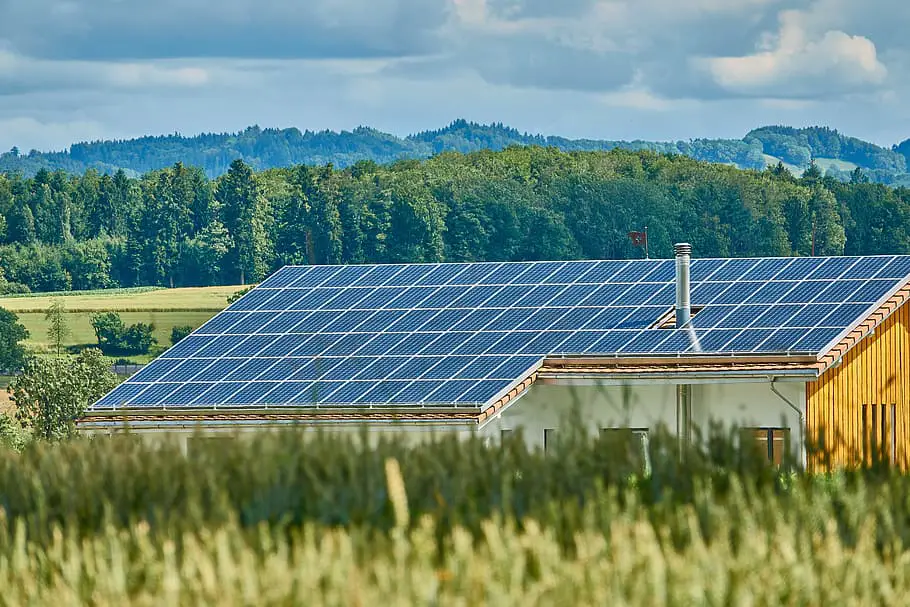
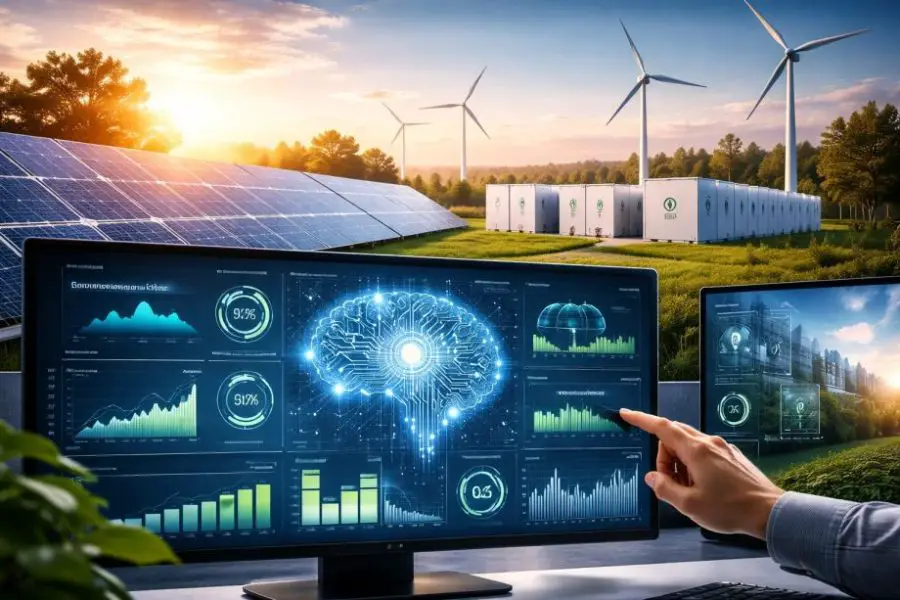
AI in renewable energy isn’t about robots “saving the planet.” It’s about using better data and smarter forecasting so solar, wind, storage, and the grid work together smoothly — even when the weather doesn’t cooperate.
✅ Start Here
Solar and wind are clean, but they’re also variable. Clouds roll in. Wind slows down. Demand spikes during a heat wave.
AI helps make clean power feel reliable by predicting what’s coming and coordinating what happens next — especially with smart grids, storage, and demand response.
If you want the “systems view” of clean energy, start here too: Clean Energy Sources: A Comprehensive Guide.
📦 What You’ll Learn
- ✅ What AI actually does in energy systems (in plain English)
- ✅ Why forecasting is the secret sauce for renewables
- ✅ Where AI helps most: smart grids, energy storage, and efficiency
- ✅ Real examples you’ll recognize (home, EVs, buildings, utilities)
- ✅ Limits and risks to watch out for (no hype)
🤖 AI in Renewable Energy: How Data Makes Clean Power Reliable
Here’s the simplest way to think about it: clean energy isn’t one technology — it’s a team sport.
You’ve got generation (solar/wind/hydro), the grid (transmission/distribution), storage (batteries and beyond), and demand (homes, businesses, EVs). AI is the “coach” that helps the team work together with fewer mistakes and less waste.
And no, you don’t need to be a tech person to get this. We’ll keep it practical.
1️⃣ 🧠 What AI Actually Does in Renewable Energy (Plain English)
✅ AI vs automation vs “smart” tech
A lot of energy tech gets labeled “smart,” so let’s clean up the terms:
- ✅ Automation is rules-based: if X happens, do Y.
- ✅ AI/machine learning looks at data, learns patterns, and improves decisions over time.
- ✅ Smart systems usually mean sensors + communication + controls. They can use AI, but they don’t have to.
So when you hear “AI in clean energy,” the practical version is usually: better prediction + better timing + better control.
🌦️ Why renewables need forecasting
Traditional power plants can be scheduled fairly predictably. Renewables are different:
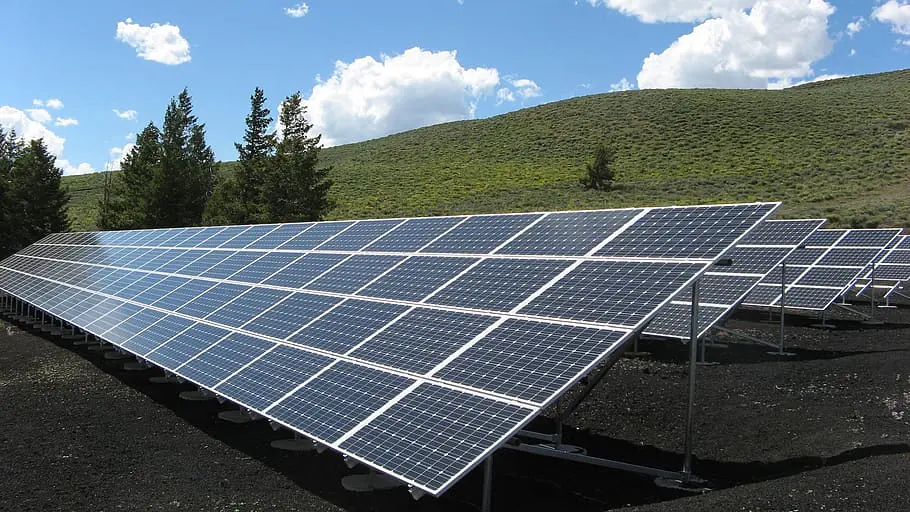
- 🌞 Solar output changes with clouds, season, shading, and even wildfire smoke.
- 💨 Wind can ramp up or drop fast depending on weather patterns.
- ⚡ Demand also changes (workday vs weekend, heat wave vs mild spring day).
The grid still has to balance supply and demand in real time. That’s why forecasting matters so much. If you can predict what’s coming, you can plan instead of panic.
🧰 The “big jobs” AI does in energy systems
When AI is used well, it usually focuses on a handful of high-impact tasks:
- 📈 Forecast supply (how much solar/wind generation is likely soon)
- 📉 Forecast demand (when peaks will happen and how large they’ll be)
- 🔋 Optimize storage (when to charge/discharge, and how hard)
- 🔌 Support grid operations (congestion management, fault detection, smoother power flow)
- 🏠 Reduce waste (buildings, HVAC schedules, load shifting)
Learn more about:
- 🔌 The Significance of Smart Grids in Clean Energy
- 🔋 Energy Storage Explained: The Missing Link in Renewable Power
- ⚡ Energy Efficiency Is Clean Energy: The Fastest Way to Cut Emissions
2️⃣ ⚡ Where AI Makes the Biggest Difference (And Why It Matters)
Let’s keep this grounded: AI helps most where energy systems are complex, fast-moving, and expensive to get wrong.
🔌 Smart grids: AI + sensors + two-way communication
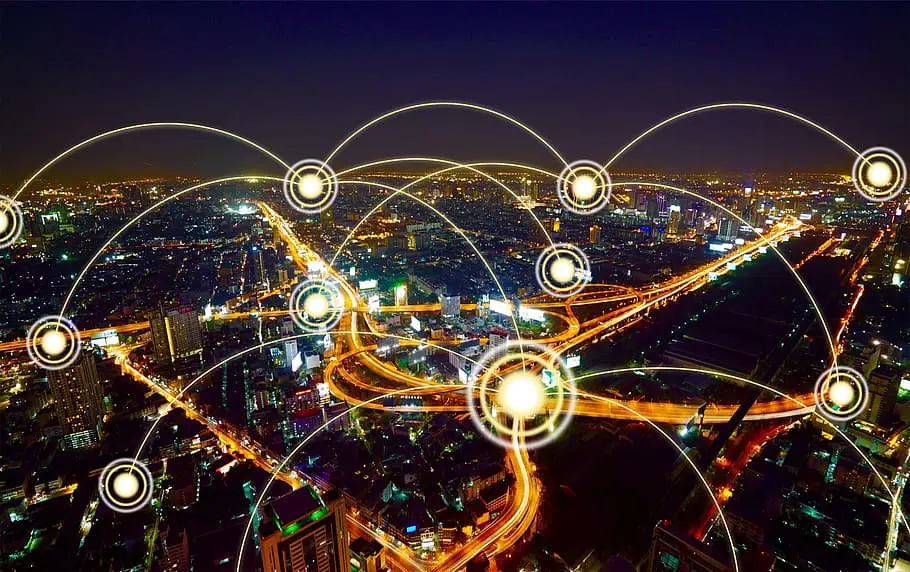
Smart grids already collect more real-time information than older grids. AI makes that data more useful by finding patterns and acting faster than humans can.
- 🧭 Earlier problem detection (spot equipment stress, anomalies, and faults faster)
- 🔁 Better balancing (route power where it’s needed, reduce congestion)
- ⏱️ Smarter demand response (shift load off peak and reduce strain)
If you want the grid story first, this internal link is the hub: The Significance of Smart Grids in Clean Energy.
🔋 Energy storage: making clean power feel “always on”
Storage isn’t just “backup.” It’s timing. It lets you move energy from when it’s abundant to when it’s needed.
AI helps answer the real questions:
- ⏱️ When should the battery charge?
- 💸 When should it discharge to avoid expensive peak power?
- 🧠 How do we avoid wearing the battery out faster than necessary?
- 🧯 How do we stabilize the grid during short disruptions?
That’s why storage + AI is such a strong combo. The storage guide you’re building around is here: Energy Storage Explained: The Missing Link in Renewable Power.
⚡ Energy efficiency: AI reduces waste automatically
Efficiency is the “clean energy you don’t have to generate.” AI helps efficiency by spotting waste patterns and optimizing schedules — especially in buildings.
- 🌡️ Smarter HVAC schedules (comfort without overcooling/overheating)
- 💡 Identifying “always-on” loads that quietly rack up usage
- 📉 Flattening peaks (which helps the grid and reduces costs)
This is the exact internal link for the efficiency hub: Energy Efficiency Is Clean Energy: The Fastest Way to Cut Emissions.
🚗 EV charging: AI helps prevent a new peak problem
EVs are great, but charging can create new demand spikes if everyone plugs in at the same time (hello, dinner hour). Smart charging is one of the easiest wins for a cleaner, smoother grid.
- ✅ Shift charging to off-peak hours (often cheaper)
- ✅ Align charging with renewable availability when possible
- ✅ Reduce local stress on distribution equipment
If you’re tying EVs into this category, keep this anchor locked: Electric Vehicles Are More Than Just Cars.
🌍 Climate and forecasting systems (supporting layer, not the headline)
One underrated benefit of AI: better forecasting tools can help utilities and communities plan for extremes (heat waves, storms, cold snaps) that stress both demand and supply.
- 🌧️ Better weather modeling improves renewable forecasting
- 🔥 Helps plan for peak demand and reliability during extreme events
- 🧭 Supports resource planning (where upgrades matter most)
Supporting internal link (exact): The Use Of AI In Predicting Climate Change: 2 Important AI Techniques.
3️⃣ 🧩 Real Examples, Limits, and What to Watch Out For
✅ Real-world examples (simple, relatable)
Here are a few examples that show what “AI in renewable energy” looks like in real life:
- ☁️ Cloudy-day solar forecasting: Predict cloud cover so grid operators don’t over-rely on fossil backup.
- 🔋 Battery dispatch: Charge when renewables are abundant, discharge during peak demand to reduce cost and emissions.
- 🏢 Smarter buildings: A building “pre-cools” slightly before peak hours to reduce strain later.
- 🚗 Smart EV charging: Charging shifts to late evening or midday solar-heavy periods instead of stacking at 6 p.m.
If you want the deeper renewable-focused AI angle, this existing post can stay as a supporting link (not a competitor): Impact of AI on Renewable Energy Production:3 Best Uses Of AI.
🚧 What AI can’t magically fix
AI is powerful, but it’s not a substitute for physical upgrades and good planning. A few reality checks:
- 🚧 Grid bottlenecks: If transmission is constrained, data alone can’t move electrons through a congested line.
- 🔌 Interconnection delays: Process and policy issues still matter (sometimes more than tech).
- 🧱 Bad building envelopes: AI can’t seal drafts or add insulation. It can only optimize what exists.
🔐 Risks and responsible use (keep it real)
Energy systems are critical infrastructure. When AI is involved, a few issues deserve serious attention:
- 🔐 Cybersecurity: More connectivity can increase attack surface if not protected properly.
- 🧾 Data quality: Bad data leads to bad decisions (and “bad decisions” on a grid can be expensive).
- ⚖️ Transparency and fairness: Especially in pricing programs, demand response, and automated control.
If you want the ethical lens in your internal linking system, keep this exact anchor: Ethics and AI: 4 Powerful Insights for the Future.
🧠 A simple way to think about AI in clean energy
If you remember one framework, use this:
- ✅ AI is a decision tool, not a magic replacement for infrastructure.
- ✅ AI works best when it supports efficiency + storage + smart grids.
- ✅ The goal isn’t “more AI.” The goal is more reliability with less waste.
✅ Key Takeaways
- 🤖 AI helps renewables by forecasting supply and balancing demand.
- 🔌 Smart grids use data + controls to improve reliability and efficiency.
- 🔋 AI improves storage decisions, reducing cost and improving stability.
- ⚡ AI supports energy efficiency, but it can’t replace basic building upgrades.
- 🔐 Responsible AI depends on good data, strong security, and transparency.
🌿 Conclusion
Renewables don’t fail because they’re “weak.” They fail when the system around them is dumb, slow, or disconnected.
AI is one of the tools helping clean energy grow up by predicting what’s coming and coordinating what happens next. When it’s used responsibly, it helps solar and wind feel more consistent, makes storage more effective, and makes the grid more resilient.
If you want to understand the whole system (in the right order), read these next:
- 🔌 The Significance of Smart Grids in Clean Energy
- 🔋 Energy Storage Explained: The Missing Link in Renewable Power
- ⚡ Energy Efficiency Is Clean Energy: The Fastest Way to Cut Emissions
❓ AI in Renewable Energy FAQs
How is AI used in renewable energy?
AI is used to forecast renewable generation, predict demand, optimize battery charging and discharging, improve grid monitoring, and reduce waste in buildings and systems. In practice, it’s mostly about better timing and better decisions using real-world data.
Does AI make solar and wind more reliable?
It can. AI improves reliability by forecasting weather-driven output and helping the grid plan ahead. When paired with storage and demand response, those forecasts translate into smoother, more stable electricity supply.
How does AI help energy storage systems?
AI helps storage by deciding when to charge, when to discharge, and how to minimize battery wear. It can also coordinate storage with renewable production and peak demand periods for better cost and grid stability.
What is the difference between smart grids and AI?
Smart grids are an upgraded grid with sensors, communication, and controls. AI is a tool that can use smart-grid data to improve predictions and decisions. You can have a smart grid without AI, but AI often works best when the grid is already “smart.”
Are there risks to using AI on power grids?
Yes. Key risks include cybersecurity concerns, poor data quality, and lack of transparency in automated decisions. That’s why strong security practices, oversight, and clear policies matter when AI is used in critical infrastructure.
📚 References & Further Reading
- U.S. Department of Energy – Grid Modernization & Smart Grid Programs
- U.S. Department of Energy – Energy Storage (Office of Electricity)
- National Renewable Energy Laboratory (NREL) – Grid Modernization Research
- U.S. Department of Energy – Alternative Fuels Data Center (EVs & Electrification)
- MIT Energy Initiative – Renewable Energy Research